CHÖRAB · 曲熱影畫 ཆོས་རབ་ · Shadow & Sound
← 返回曲熱影畫總目 · Back to Archive
卷貳 · VOL. II · 6 FILMS

《千古人物集》 Portraits Across Millennia · 歷史故人與詩詞靈魂微電影

不寫廟堂碑文,只寫歷史長夜裡真實呼吸過的人。十八歲燃盡生命畫出《千里江山圖》的少年王希孟、率五十騎直闖五萬金營的青年辛棄疾、黃州夜雨裡自嘲的蘇東坡、金石零落仍傲骨錚錚的李清照,以及春花秋月裡回望故國的李煜,片中均附館藏與正史考據小注。

Intimate 35mm musical portraits of luminous souls across Chinese history—18-year-old painter Wang Ximeng, warrior-poet Xin Qiji's raid with fifty cavalry, Su Dongpo in exile, Li Qingzhao, and Southern Tang poet-king Li Yu—grounded in primary museum and historical archives.

千古人物集
千古人物集 Sleeve
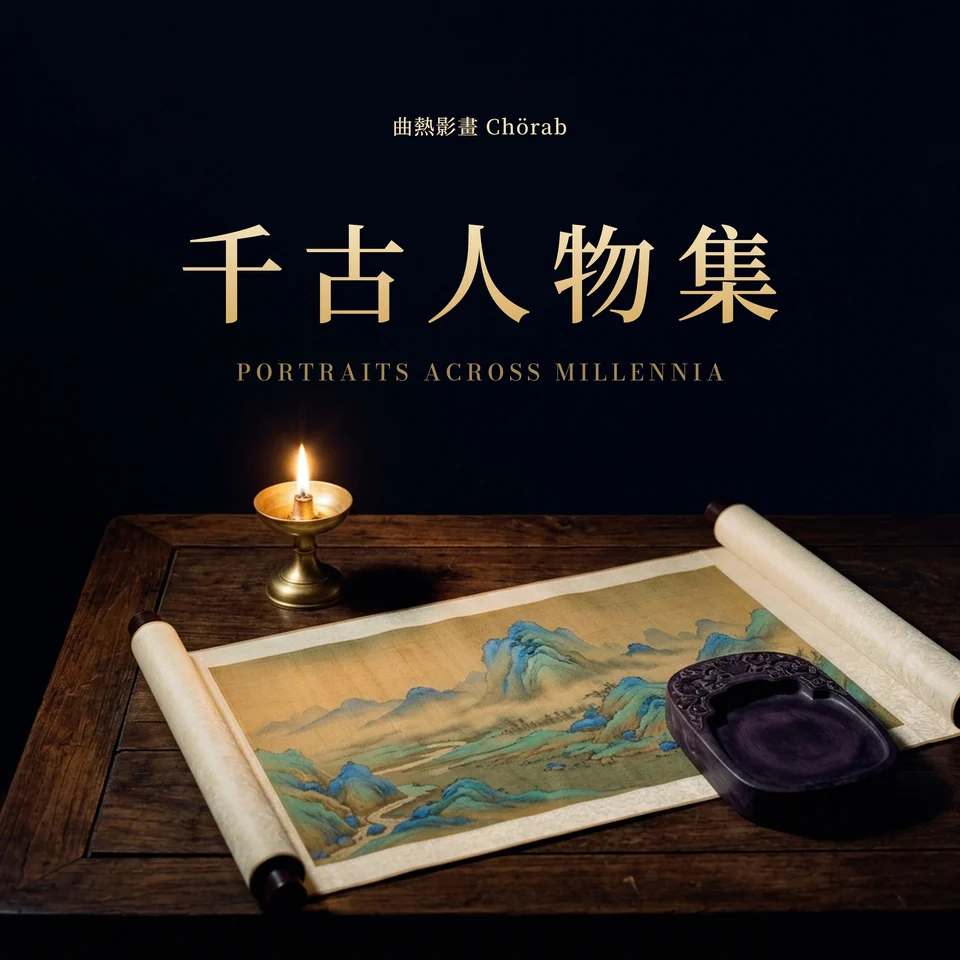
《千古人物集》Song Dynasty Oil Lamp & Blue-Green Scroll · 35mm Cinema Key Art35MM ANAMORPHIC
《挑燈的人》The Lamp Lighter
REEL 01 · 02:34.4

《挑燈的人》 The Lamp Lighter

以跨越千年的「過來人」視角,串聯二十七歲始發憤讀書的蘇洵、五十四歲積勞病逝於五丈原案頭的諸葛亮,以及六十歲後作詩自嘲健忘的白居易。溫暖原聲鋼琴、古琴泛音與室內弦樂緩緩對話,映照今日凌晨一點檯燈下的苦讀少年、連軸轉的中年與把記憶全分給家人的父母,在長夜裡輕輕將燈芯撥亮一寸。

"The Lamp Lighter" brings three historical figures from Chinese letters and statecraft into quiet conversation with modern everyday exhaustion: Northern Song essayist Su Xun, who began serious study only at twenty-seven and knew exam-hall despair; Three Kingdoms chancellor Zhuge Liang, who burned candles over military dispatches until his death at fifty-four on the Wuzhang Plains; and Tang poet Bai Juyi, who wrote humorously of failing memory past sixty. Scored for felted piano, guqin harmonics, xiao flute, and chamber strings, it honors late-night students, overburdened workers, and aging parents.

《我是蘇東坡》I Am Su Dongpo
REEL 02 · 04:08.4

《我是蘇東坡》 I Am Su Dongpo

從二十一歲名動汴京、歐陽修盛讚,到烏臺詩案百三十日死牢,再一路貶謫黃州、惠州直至六十二歲渡海遠赴儋州,蘇軾(蘇東坡)在最落魄的歲月裡開荒東坡、慢煨紅燒肉,寫下《定風波》與《念奴嬌》。曲作以竹笛、古琴、原聲吉他與弦樂相融,道出「竹杖芒鞋輕勝馬,一蓑煙雨任平生」的曠達。

"I Am Su Dongpo" is a first-person musical portrait of Northern Song literary master Su Shi (Su Dongpo, 1037–1101). Tracing his fall from early fame under Ouyang Xiu to 130 days of imprisonment during the Crow Terrace Poetry Trial and decades of exile across Huangzhou, Huizhou, and Hainan's Danzhou, the narrative weaves his everyday resilience—farming the Eastern Slope and simmering Dongpo pork in a clay pot—into famous verses from "Calming the Waves" (Dingfengbo), scored for bamboo flute, guqin, acoustic guitar, and warm strings.

《我是李清照》I Am Li Qingzhao
REEL 03 · 03:52.0

《我是李清照》 I Am Li Qingzhao

前半生是汴京月光下與趙明誠逛相國寺、賭書潑茶的明媚歲月,後半生是靖康戰火後護著十五車青銅古籍渡江南下、歷經牢獄亦不折腰的四十年風雨。作品跳出「尋尋覓覓」的單一婉約印象,以古箏、琵琶、簫與戲劇化弦樂交織,重現李清照於烏江畔寫下「生當作人傑」與「九萬里風鵬正舉」的錚錚傲骨。

"I Am Li Qingzhao" chronicles the two halves of Song Dynasty poet Li Qingzhao's life (1084–c.1155): her luminous youth in Bianjing collecting epigraphic rubbings at Xiangguo Temple and spilling tea over literary games with husband Zhao Mingcheng, followed by the Jingkang catastrophe, widowhood in Jiankang, safeguarding fifteen carts of bronzes and rare texts across turbulent rivers, and standing unbowed through imprisonment. Scored for guzheng, pipa, xiao flute, piano, and dramatic strings, it pairs her delicate ci lyrics with her heroic Wu River quatrain.

《破陣子·五十騎》Fifty Cavalry
REEL 04 · 04:32.8

《破陣子·五十騎》 Fifty Cavalry

公元一一六二年寒夜,二十二歲的辛棄疾率五十披甲鐵騎直闖五萬金兵連營,於漫天箭雨與風雪中破圍南歸;四十年後江南雨夜,滿頭白髮的詞人挑燈看劍,將平生壯志寫入《破陣子》。作品以戰鼓、琵琶掃弦、蒼勁竹笛與交響銅管弦樂推進,重現「馬作的盧飛快,弓如霹靂弦驚」的金戈鐵馬與孤勇。

"Fifty Cavalry" dramatizes the true 1162 night raid of twenty-two-year-old warrior-poet Xin Qiji (1140–1207), who led fifty armored horsemen through a Jin army camp of fifty thousand before spending four decades sidelined in Southern Song Jiangnan. Structured around his famous heroic ci poem "Pozhenzi" ('Drunk, I trim the lamp to examine my sword'), the composition combines driving Chinese war drums, percussive pipa strumming, suona and bamboo winds, brass, and cinematic strings to capture unbroken courage across youth and white-haired age.

《千里江山》A Thousand Li of Rivers and Mountains
REEL 05 · 04:27.2

《千里江山》 A Thousand Li of Rivers and Mountains

北宋政和三年,十八歲的畫學學生王希孟歷經無數次「還不夠好」的退回,得宋徽宗親授筆法,以石青作天、石綠作山,用半年光陰繪就近十二米長的《千里江山圖》,僅在蔡京題跋留名後便消失於史冊。九百年後故宮展櫃前,竹笛、古琴、鋼琴與恢弘弦樂鋪開青綠長卷,與今日迷茫的十八歲少年隔窗對話。

"A Thousand Li of Rivers and Mountains" tells the story of Northern Song prodigy Wang Ximeng, who at age eighteen in 1113 AD ground mineral azurite (shiqing) and malachite (shilü) to paint a nearly twelve-meter blue-and-green landscape handscroll under Emperor Huizong's tutelage—recorded only in a brief colophon by Cai Jing before disappearing from history. Bridging the Song Imperial Painting Academy and modern visitors queuing at Beijing's Palace Museum, the arrangement pairs crystalline piano, bamboo flute, guqin, and sweeping orchestral strings.

《我是李煜:誤作帝王家》I Am Li Yu
REEL 06 · 04:45.0

《我是李煜:誤作帝王家》 I Am Li Yu

本該在江南煙雨裡寫詞畫竹的李煜(937–978),偏偏誤生帝王家;當北方鐵騎踏碎秦淮月色,昔日南唐後主淪為汴京小樓囚徒,於梧桐深秋與昨夜東風裡寫下《虞美人》《相見歡》與《浪淘沙》。幽咽二胡、琵琶、洞簫與深沉大提琴交織,訴說那份不為王座、只為故國舊夢與赤子真情而流的千古離愁。

"I Am Li Yu" portrays Li Yu (937–978), the last ruler of the Southern Tang and acclaimed master of Chinese ci poetry, whose gentle artistic temperament was ill-suited to kingship. Following the fall of Jinling along the Qinhuai River and his captivity in Northern Song Bianjing, he composed timeless elegies including "Yu Meiren" ('Like a river of spring water flowing east') and "Langtaosha." Arranged for mournful erhu, pipa, dongxiao flute, piano, and solo cello, the ballad meditates on lost youth and tender vulnerability.